

6 Practical Uses of Foot Traffic Data for Your Store Network
Foot traffic data is revolutionizing how retail brands analyze and optimize their store networks. Discover 6 practical use cases.
 Vincent Dechandon
April 21, 2022
Guide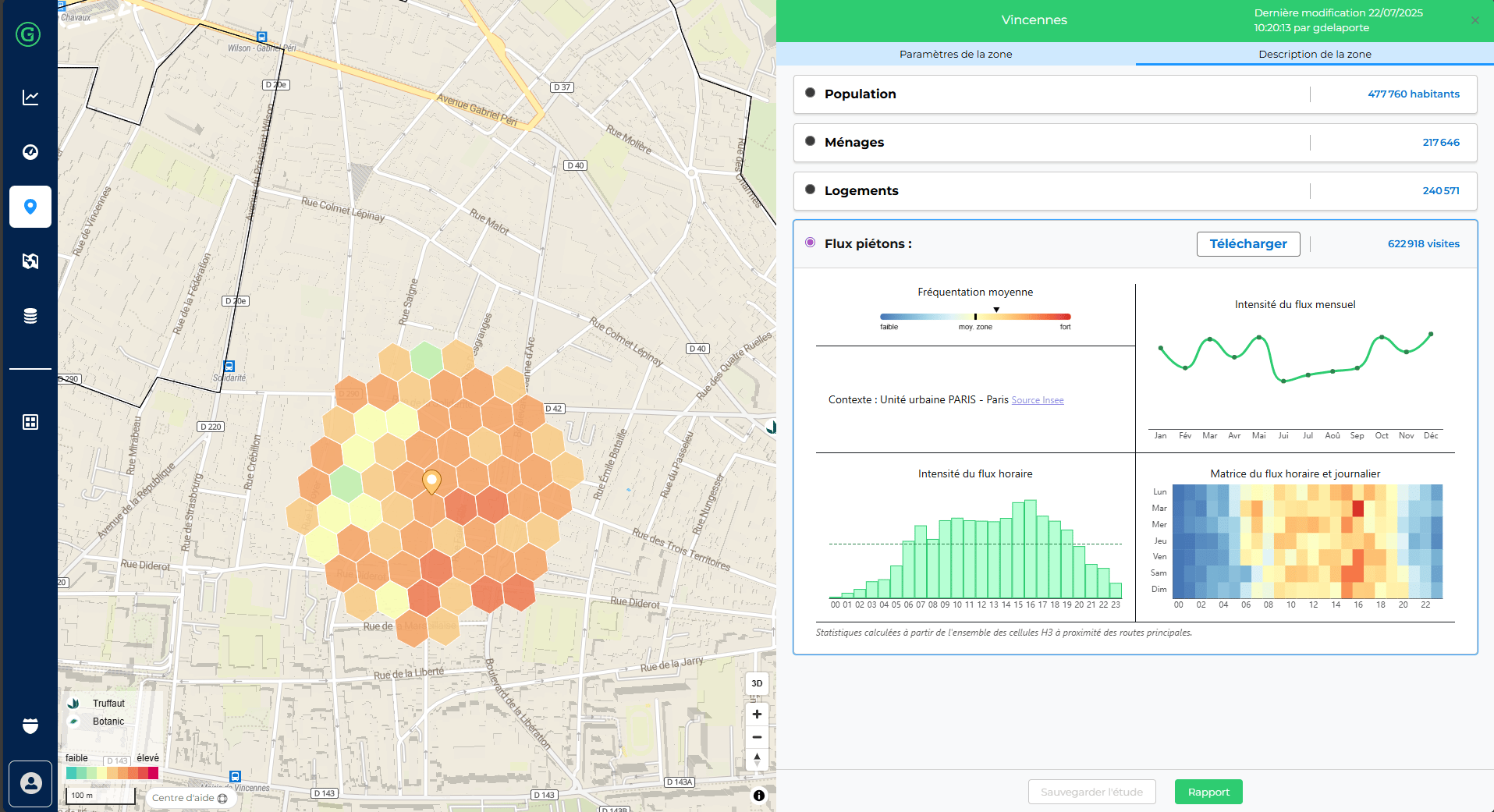
1. Know the foot traffic in front of and near your points of sale
Having a precise picture of average annual, monthly, and daily traffic at a specific address tells you whether the point of sale is located in a relevant area or not. But that is not all.
Understanding the traffic intensity near that address is equally valuable, as it allows you to see at a glance whether adjacent streets potentially attract more traffic, or whether the store is indeed in an ideal location.
The foot traffic data available in Galigeo lets you do both with a single click.
A Galigeo report showing annualized traffic at 87 Avenue d'Italie in Paris. The address is situated in a densely trafficked area compared to other zones within a 200-meter radius.
2. Compare multiple opening projects / Select the best opening projects
Foot traffic data can be leveraged to compare two or more addresses and determine which one offers the best visibility.
Note that this comparison can also be made between one of your existing stores and a site selection project, or even with competitor points of sale.
Foot traffic data enables you to compare and select the best opening projects.
Comparing the foot traffic of two nearby addresses reveals which one will have the best exposure during different periods of the year.
3. Better target your real estate prospecting areas
To maintain a high-performing store network, you need optimized network coverage. Achieving this requires finding new areas and catchment zones where it makes sense to open a location.
Foot traffic data can help by quickly detecting these promising areas, highlighting locations where traffic intensity is highest at the scale of a city, a catchment area, or even an entire department.
Obtaining a macro view of foot traffic intensity at a large scale — here around Rennes — reveals the most frequented locations without having to randomly test numerous addresses.
4. Determine predictive revenue from foot traffic-based models
Our solution offers users various predictive revenue calculation models, developed from foot traffic data by our data scientists and geomarketing experts.
The models we provide work by combining multiple datasets, including: foot traffic, your own stores' business data, public data on competitor stores, or similar businesses.
Whether working independently or supported by our consultants, our clients can anticipate the revenue of a future point of sale. Foot traffic data helps you validate an opening project with greater confidence.
Incorporating foot traffic data into predictive revenue models improves revenue forecasting accuracy by nearly 15%.
5. Renegotiate your commercial leases
We regularly observe disagreements among our clients between landlords and retail brands regarding commercial leases.
When marketability factors are impacted by changes in the local environment (extended construction work, road infrastructure changes, bus stop removals, etc.), these changes can deteriorate a location's attractiveness and consequently the intrinsic value of the site.
The evolution of a location's attractiveness can be analyzed through changes in foot traffic. This data is a powerful asset during commercial lease renegotiations.
Knowing whether foot traffic has been trending upward or downward over several consecutive months in front of a commercial location provides a solid argument when lease (re)negotiation time comes.
6. Improve your local marketing efforts
You can analyze foot traffic in front of an advertising spot and determine the visibility it can provide.
Analyzing where pedestrians passing near an advertising location come from helps you determine whether they will subsequently pass near one of your points of sale.
Our solution enables you to select the most suitable advertising spots for your local marketing campaigns.
During a sporting event — for example, the 2024 Olympic Games — knowing the foot traffic intensity in front of bars and brasseries in Paris helps prioritize where to focus marketing and sales efforts.