

Generate a Local Market Report (LMR) in 1 Click for Your Franchise Network
The Local Market Report is a key document for franchise networks. Discover how geomarketing enables its automatic generation.
 Vincent Dechandon
July 18, 2024
Guide
What Is a Local Market Report?
The Local Market Report (LMR) is a legally mandated document required under franchise agreements by the French Commercial Code. It is designed to provide prospective franchisees with a detailed analysis of the trade area.
This report includes demographic, socioeconomic information, as well as a precise assessment of competition within the relevant geographic area.
Its purpose is to offer franchisees a solid, objective foundation for making informed decisions about a new location project, while complying with legal requirements for transparency and disclosure.
The primary goal is to ensure that both the franchisee and the franchisor have all the data needed to evaluate the potential of a new point of sale opening.
A Legal Requirement for Franchises
The Local Market Report (LMR) is mandatory for franchises under the Doubin Law (Article L330-3 of the French Commercial Code), which requires the provision of a Pre-Contractual Information Document (DIP) including the LMR at least twenty days before contract signing.
The LMR protects prospective franchisees by providing a detailed analysis of the trade area, including demographic, socioeconomic, and competitive data, enabling them to make informed decisions. It also ensures transparency, strengthens the franchisor's credibility, and helps prevent disputes by providing objective, factual information about the local market.
Article: How to prepare your Pre-Contractual Information Document as a franchisor (DIP)
The Benefits of Local Market Reports
The Local Market Report (LMR) offers numerous advantages to both franchisees and franchisors.
For franchisees, it provides a detailed analysis of the trade area, demographic, socioeconomic, and competitive data, along with many other elements we will explore later in this article. This helps assess the commercial potential of a new location project.
For franchisors, the LMR ensures transparency and strengthens credibility, facilitating the recruitment of new franchisees. It also helps prevent disputes by providing objective information that complies with legal requirements, thereby ensuring a lasting relationship of trust between the parties.
Local Market Reports guarantee transparency and protect both the franchisee and the franchisor.
LMR vs. Market Study
The Local Market Report and a market study differ primarily in their purpose and content.
The LMR is a legally mandated document for franchises, providing a detailed and objective analysis of the trade area and its key indicators, which we will examine in the next section, without offering quantified revenue forecasts. Its purpose is to enable franchisees to make informed decisions based on tangible, objective information.
A market study, on the other hand, is a broader, more customized analysis conducted to evaluate business opportunities and forecast future performance, often including revenue projections and a wide range of additional indicators.
Go beyond the LMR by adding quantified and predictive (AI) data:
Discover how to conduct market studies for your next site selections in just a few clicks (coming soon)
White Paper on Predictive Revenue
Discover how to obtain a predictive revenue estimate in just a few clicks from a simple address to assess the potential of a location for a future opening.
Download the white paper
What Does a Local Market Report Contain?
Geographic situation (trade area)
The LMR analyzes the geographic situation, including the trade area (isochrone), which measures accessibility and travel time to the point of sale as well as all transportation infrastructure.
Median income
The local report provides information on the median household income in the area, which is essential for assessing purchasing power and commercial potential.
Sociodemographic data (INSEE)
The LMR uses sociodemographic data from INSEE, such as age, gender distribution, and socio-professional categories, to understand the local population.
Housing data
The LMR includes housing data, such as the proportion of homeowners and renters, as well as dwelling composition, to assess residential stability.
Market and consumer data
The LMR analyzes market and consumer data, providing insights into purchasing habits and consumer behavior in the area.
Competition
The LMR evaluates local competition by identifying competing businesses, their activities, locations, and revenue. This information is primarily sourced from the SIRENE database.
Our solution allows you to generate your LMRs as well as studies that provide additional depth with these 3 other essential elements:
Points of interest and attraction:
The study identifies all points of interest and attraction located near the future point of sale.
Mobility flows:
The study delves deeper into mobility patterns around the future point of sale. Obtaining quantified foot traffic and vehicle flow data by year, or by hour, day, or month at the storefront level or near the point of sale helps assess the commercial potential of a location.
Predictive revenue:
Calculating and displaying predictive revenue for a future point of sale within the study enables a more precise evaluation of the project's commercial potential.
Request your personalized demo
Generate Your LMR in 1 Click with Galigeo
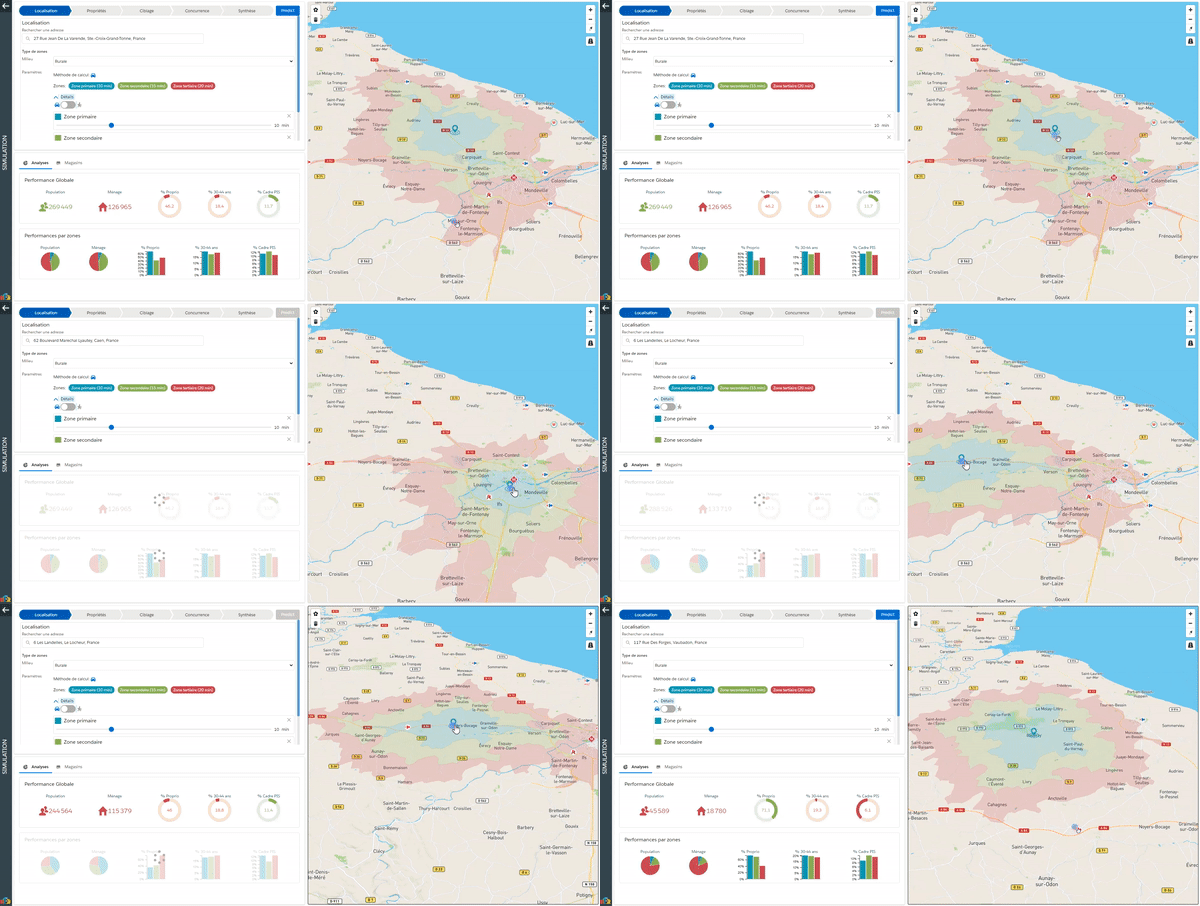
Trade area calculation
Generate a trade area from an address in 1 click.
2. Enter your network information
Useful information such as: Business sector, Your points of sale, Competitors, Points of interest and attraction, Relevant sociodemographic indicators, Etc.
3. LMR generation in 1 click
Download your LMRs in PDF and Excel format in 1 click.
A Solution Dedicated to Franchisor Networks
Discover in this article how our solution supports franchisors from A to Z in managing their network. Generating LMRs, predictive revenue calculation, identifying conquest zones, analyzing network coverage, discovering cannibalization zones, determining key success factors, analyzing performance indicators -- these are just some of the use cases that franchisors can address in a few clicks on our all-in-one solution.