

The 30 Essential Key Indicators to Evaluate the Performance of Your Points of Sale
Discover the 30 essential performance indicators grouped into 4 categories to effectively manage your store network.
 Vincent Dechandon
October 13, 2023
Guide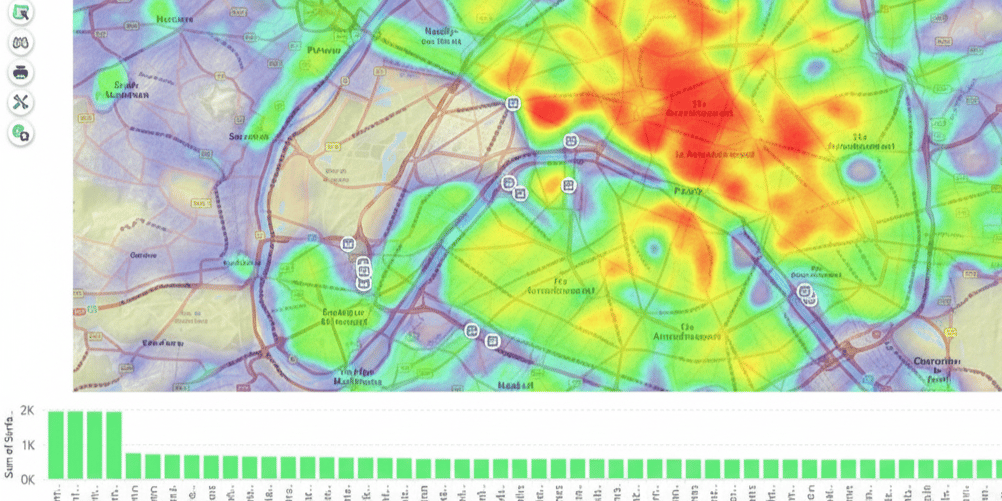
Retail Financial Indicators
Tracking financial indicators in the retail world allows you to monitor the financial performance of your entire network and each of your points of sale.
As a reminder: you can track all these KPIs at a glance using our retail performance analysis solution.
Customer Acquisition Cost (CAC)
CAC (Customer Acquisition Cost) is an indicator often used in the digital customer acquisition world but is equally applicable to customer acquisition for your points of sale.
Calculating CAC helps determine how much you need to invest to acquire a new customer. Ultimately, this metric is used to calculate the profitability of marketing campaigns.
The formula:
Customer acquisition cost = Total campaign budget / Number of new customers
Tracking the evolution of this metric allows you to analyze whether your customers are costing more or less to acquire over time.
Customer Lifetime Value (CLTV)
Customer Lifetime Value (CLTV) is an indicator that corresponds to the total sales generated over the average lifetime of a customer, i.e., the average time a company retains a customer.
Customer Lifetime Value = (average sales value) x (average number of sales) x (average customer relationship duration) = The average revenue generated by your customers throughout their lifetime.
It is essential to compare the customer lifetime value to the customer acquisition cost, i.e., the amount of revenue generated by a customer versus the amount spent to acquire them. Indeed, calculating CLTV can even help determine the maximum CAC, i.e., the limit of the sales and marketing budget for acquiring a new customer.
Revenue Trends Over Time (Month, Quarter, Year)
It is important to track revenue trends to compare them against previous months, quarters, or years.
Formula:
Year-over-year sales = ((Current year sales - Previous year sales) / Previous year sales) * 100%
Cost of Goods Sold (COGS)
The Cost of Goods Sold (COGS) indicator refers to the direct costs of producing goods sold by a company. This amount includes the cost of materials and labor directly used to create the product. It excludes indirect expenses such as distribution costs, sales force costs, and communication-related costs.
Analyzing the cost of goods helps track the evolution of production costs.
Operating Expenses Trends (OPEX)
Your operating expenses represent all costs associated with running your business. These include rent, inventory, insurance, salaries, and more.
Analyzing these operating expenses allows you to track spending directly related to the operation of your points of sale.
It is advisable not to limit yourself to simply tracking the evolution of these expenses but to analyze them relative to revenue.
Operating expense ratio: (Total operating expenses / Revenue) * 100
Quick Ratio
The quick ratio, or liquidity ratio, is considered a benchmark indicator for quickly assessing a company's financial health. The liquidity ratio measures a company's ability to meet its short-term liabilities without selling inventory.
Quick ratio = (cash + marketable securities + accounts receivable) / short-term liabilities.
A ratio greater than one is desirable and means the company is generally in good financial health.
Current Ratio
The current ratio is another commonly used financial metric for assessing a company's health. Like the quick ratio, it measures a company's ability to meet its obligations.
However, this ratio takes a more realistic approach and checks whether a company can meet its obligations within one year.
Current Ratio = Current assets / Current liabilities
Just like the Quick Ratio, if this ratio is greater than one, it means the company is in good financial health.
Cash Conversion Cycle
The cash conversion cycle is a cash flow indicator that quantifies the time it takes a company to convert its inventory into cash.
The shorter the cycle, the better the cash flow.
Cash conversion cycle = days inventory outstanding + days sales outstanding - days payable outstanding.
Days inventory outstanding: the number of days an item stays in your inventory, from arrival to sale.
Days payable outstanding: the number of days you have to pay your suppliers.
Days sales outstanding: the number of days it takes to collect payment for your sales.
Days Sales Outstanding (DSO)
This financial indicator measures the average time needed to receive payment after a sale. The lower this time, the better your cash flow.
DSO is part of the working capital requirement estimation. Calculating DSO is relevant when a company makes credit sales.
DSO = (accounts receivable / revenue) x number of days
Days Payable Outstanding (DPO)
The Days Payable Outstanding (DPO) is a ratio that measures the average number of days a company takes to pay its suppliers.
Unlike DSO, the higher this time, the better your cash flow.
DPO = Total supplier debt / Total cost of goods sold x 360
Gross Margin Return on Investment (GMROI)
This metric allows retail and distribution players to evaluate the profitability of their inventory. They capture significant gains by simultaneously acting on the two components that most impact their cash flow: the cash "generated" by the margin and the cash "tied up" by inventory.
The higher the ratio, the greater your margin on each product. However, selling products with a very high GMROI ratio does not always mean earning a lot of money. It is important to consider the number of sales you make, the margin, and the initial cost of products.
GMROI = Gross margin / Average inventory cost
This article will allow you to deepen your analysis of financial performance in the retail world.
Retail Sales Performance Indicators
Tracking sales-related indicators and metrics in the retail world allows you to monitor the sales performance of your network and each of your points of sale.
As a reminder, you can find and analyze all these indicators in your reports on Power BI, SAP BI, Qlik, IBM Cognos, etc.
Conversion Rate
The conversion rate corresponds to the percentage of visitors who made a purchase. The evolution of this metric indicates your ability to convert visitors into customers. Evaluate the effectiveness of actions taken within points of sale to improve your conversion rate.
Conversion rate: (Number of transactions / Number of visitors) x 100
Average Transaction Value (ATV)
This metric tells you the average amount a customer spends per visit. The evolution of this indicator is essential for analyzing whether your implemented actions encourage customers to buy more products or higher-value products.
Average transaction value = Revenue / Number of transactions
Average Number of Items Purchased Per Basket
This indicator tracks the number of items purchased per shopping session. This number primarily evolves based on certain commercial and marketing actions carried out within your points of sale, such as merchandising, promotions, advertising, your teams' selling capabilities, cross-selling techniques, and shelving products that meet customer needs, etc.
Tracking the evolution of this indicator allows you to evaluate the effectiveness of actions taken to increase the number of products purchased per visit.
Number of Sales Per Employee (Amount and Volume)
This indicator allows you to track both the overall performance of the store and that of individual sales associates.
Following the analysis of the amount or volume of sales per employee, you can reposition your staff within the point of sale, send them to specific training, anticipate problems, organize a bonus system, reorganize your teams, etc.
This article will allow you to deepen your analysis of sales performance in the retail world.
Retail Merchandising and Inventory Performance Indicators
Tracking merchandising-related indicators and metrics in the retail world allows you to monitor merchandising performance for your network and each of your points of sale.
Revenue Per Square Meter
This is one of the most widely used performance indicators in the retail world. Calculating revenue per square meter allows you to analyze the optimization of your sales and storage spaces.
Analyzing this indicator is especially important in urban areas, where real estate represents a significant portion of operating expenses.
Sales per square meter = Revenue / Sales area
Inventory Shrinkage
This is one of the most important retail metrics you should track. Inventory shrinkage is inventory loss attributed to any cause other than sales. Common causes of inventory shrinkage include: administrative errors, employee theft, shoplifting, and supplier fraud.
Inventory shrinkage = Final inventory value - Actual inventory value.
Inventory Turnover Ratio
This metric represents the number of times total inventory has been sold during a year. The expression often used by inventory managers, "my stock turns x times per year," indicates good procurement management.
The closer the inventory turnover ratio is to 1, the more the inventory management model needs to be reviewed. Conversely, a high turnover ratio reflects well-optimized logistics and low working capital requirements.
Average Time Products Spend in Inventory
This metric allows you to know the average time your products spend in inventory. A well-optimized procurement strategy aims to reduce the time your products spend in stock. A high average storage time may be due to oversized inventory or products that do not match customer needs.
The longer products spend in inventory, the higher your working capital requirement.
This article will allow you to deepen your analysis of merchandising performance in the retail world.
Retail Consumer Behavior Analytics Indicators
Tracking consumer behavior-related indicators and metrics in the retail world allows you to monitor the performance of your network and each of your points of sale.
Foot Traffic in Front of the Point of Sale
Obtaining the number of passersby near a point of sale provides insight into the attractiveness of the area where the point of sale is located. This indicator allows you to compare the number of passersby in front of your point of sale with that of nearby competitors or other points of sale in your network.
There are many practical uses for this foot traffic data, such as revenue forecasting, comparing multiple commercial locations, renegotiating a commercial lease, etc.
Discover the foot traffic data for any commercial location
Attractiveness Rate
The attractiveness rate represents the number of people who visited your point of sale divided by the total number of people who walked past it.
It is an excellent indicator for evaluating the effectiveness of actions implemented near the store or in window displays. Are you making passersby want to visit your point of sale?
Attractiveness rate = (Number of visitors / Number of pedestrians in front of the point of sale) x 100
Number of Transactions
The number of transactions represents the number of times all customers made a purchase at a point of sale.
This indicator allows you to analyze the effectiveness of certain commercial and marketing actions within the point of sale.
Online Sales vs. In-Store Sales
A key indicator to track for all retailers taking an omnichannel approach. Analyzing this metric will help you better understand the link between your online sales and those in your physical stores, and to what extent these distribution channels influence each other.
Does opening or closing a point of sale increase or decrease online sales? Conversely, how does an increase or decrease in online sales affect in-store sales? It is not uncommon to observe a strong correlation between your digital activities and point-of-sale operations.
FNAC DARTY case study?
Customer Retention Rate
It is 7 to 8 times more expensive to acquire new customers than to resell to existing ones. Customer loyalty is one of the main challenges in the retail world. Hence the relevance of implementing effective loyalty programs.
This retail indicator helps determine how many of your customers return to your store for a second visit (or more).
Retention rate = ((number of customers at end of period - number of new customers during period)) / (number of customers at start of period) * 100%.
Customer Satisfaction Index
This indicator determines customer satisfaction with your retail brand or specific products. This metric can be obtained through interviews or surveys sent to your customers. Like the Net Promoter Score, a scoring from 0 to 10 can be used to quantify customer satisfaction.
Regularly analyzing this metric will allow you to track the evolution of your customer satisfaction.
Net Promoter Score
The Net Promoter Score (NPS) has become an essential indicator in the retail world. It measures customer satisfaction.
Customers give a score between 0 (not at all likely) and 10 (very likely) to the question "How likely are you to recommend brand X or product X to someone you know?" These scores place them in one of three segments: Detractors: score between 0 and 6 - Passives: score between 7 and 8 - Promoters: score between 9 and 10.
The NPS is an indicator that provides an easily interpretable measure of your customers' satisfaction and their potential to become ambassadors for your retail brand.
Online Ratings
Today, the majority of consumers say they check ratings and customer reviews before purchasing a product.
Many rating sites, directories, marketplaces, and more allow consumers to quickly leave a rating and review for a product or company.
Sharing customer experience has become the norm!
"Globally, 71% of consumers consider these ratings as 'important' or even 'very important.' In France, this figure stands at 58%. An average below that of Europeans, 63% of whom consider this information important." according to LSA conso.
Tracking your ratings and reviews on major rating sites will allow you to analyze the evolution of your brand awareness and surface issues encountered by your customers within your points of sale.
Average Dwell Time
The average dwell time metric measures the time our potential customers spend inside our points of sale.
Knowing this data allows retailers to detect problems inside the store: consumer movement, lack of staff, or even inventory incidents.
The increase or decrease of this indicator helps identify incidents that would otherwise be overlooked.
Parking Lot Occupancy Rate
This indicator allows you to analyze whether your parking lot is over- or under-sized. An under-sized parking lot can be a limiting factor for customers. Meanwhile, an oversized parking lot represents space potentially available for other activities.
% of Revenue Generated Through Click & Collect
Omnichannel has become a major challenge for retailers. That is why analyzing the evolution of revenue generated through Click & Collect helps track the effectiveness of your web-to-store actions.
Adapt to the new consumption trends of your customers.
Tracking the evolution of your Click & Collect sales can give you a trend on the new purchasing behaviors of your customers and evaluate the effectiveness of your omnichannel marketing campaigns.
Revenue Trends Based on Marketing Spend
This metric allows you to correlate marketing spend with the associated revenue.
Analyze the impact of an increase or decrease in your marketing spending on your revenue.
Furthermore, it is strongly recommended to evaluate the effectiveness of your marketing campaigns by calculating the return on investment for each one.
% of revenue linked to marketing spend = (Marketing budget / Revenue) * 100
This article will allow you to deepen your analysis of consumer purchasing behavior in the retail world.
Create your own reports for your network and your points of sale for free in Power BI here
In the same vein as performance indicators, discover how to optimize the development of your network through the latest innovative geomarketing approaches in our article "Geomarketing from A to Z."